
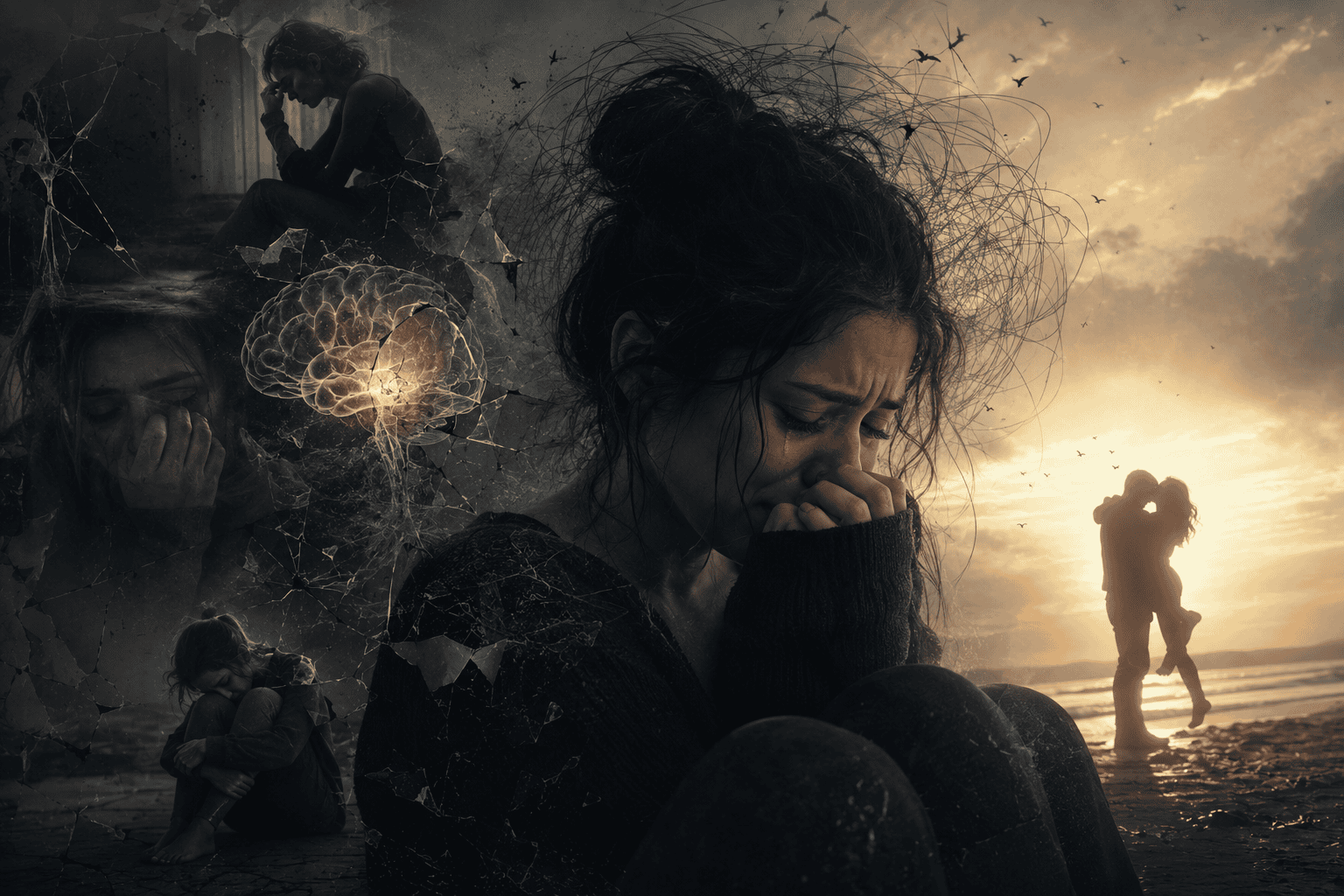
WHEN LOVE BECOMES A BATTLE BETWEEN THE PAST AND THE PRESENT
There is another part of trauma that people don’t talk about enough: what it does to the way you love.
Because when you have spent your life being hurt, love doesn’t simply become love.
It becomes hope.
It becomes fear.
It becomes attachment.
It becomes longing.
It becomes the desperate desire to finally feel safe with someone… while simultaneously being terrified that the moment you let your guard down, you will be hurt all over again.
And when your brain has been damaged by trauma and you are also living with neurological damage, loving someone can become one of the most beautiful and terrifying experiences imaginable.
I don’t love lightly.
I don’t know how to do that.
When I love someone, I love deeply.
I attach quickly.
I feel everything intensely.
I notice everything.
A change in tone.
A different message.
A pause.
A different choice of words.
A little less affection.
A little more distance.
Something that probably means absolutely nothing to someone else can become enormous inside my head.
Not because I want it to.
Not because I am trying to be dramatic.
Because my brain has learned to scan for danger.
It learned that the small things matter.
It learned that danger doesn’t always announce itself.
Sometimes it begins with a change in someone’s voice.
Sometimes it begins with distance.
Sometimes it begins with someone behaving differently.
And sometimes, by the time you realise what is happening, you are already hurt.
So my brain watches.
Constantly.
It scans.
It compares.
It analyses.
It searches for patterns.
“Is something different?”
“Did I do something?”
“Are they pulling away?”
“Why did they say it like that?”
“Is this the beginning of something?”
“Have I seen this before?”
“Is this happening again?”
And the worst part is that sometimes I know I am doing it.
I can actually hear myself thinking.
I can know that I may be overthinking.
I can know that the evidence isn’t there.
And still, something inside me screams.
“But what if it is?”
That is what trauma can do.
It can make the past feel dangerously close to the present.
And when dissociation is part of that trauma response, the boundaries between what is happening now and what has happened before can become incredibly difficult to navigate.
The brain doesn’t simply store experiences like files in a cabinet.
Traumatic memories can be strongly connected to emotions, bodily sensations, perceptions and patterns of threat. When something in the present resembles something from the past, the nervous system can react before the rational part of the mind has had a chance to catch up.
And for someone living with neurological damage involving the frontal and temporal regions of the brain, processing can become even more complicated.
The frontal regions of the brain are involved in things such as executive functioning, emotional regulation, decision-making and controlling responses. Temporal regions are involved in memory, emotional processing and interpreting information.
So imagine trying to regulate an emotional storm with a brain that has already been injured.
Imagine knowing you should calm down… but not being able to make your brain cooperate.
Imagine knowing that something might not be what you think it is, while your entire nervous system is screaming that it is.
That is the battle.
And love makes it worse because love gives you something to lose.
When I don’t care, I can walk away.
When I don’t love you, your distance doesn’t destroy me.
When I am not attached, your silence doesn’t feel like abandonment.
But when I love you?
Everything matters.
And I hate that sometimes.
I hate how quickly I can become attached.
I hate how deeply I can feel.
I hate how one person can suddenly become so important to my emotional world.
Because once someone matters to me, the possibility of losing them becomes terrifying.
And then the overthinking begins.
My brain starts looking backwards.
It searches my history for similar situations.
It searches for patterns.
It says:
“We’ve seen this before.”
“This feels familiar.”
“This is how it started last time.”
“Be careful.”
“Don’t trust this.”
“Something is wrong.”
“You’re going to get hurt.”
And sometimes the voice doesn’t stop.
It loops.
Again.
And again.
And again.
“I’m scared.”
“I’m scared.”
“I’m scared.”
“This is the same.”
“This is the same.”
“This is the same.”
Even when it isn’t.
That is perhaps one of the most painful parts of loving someone new after surviving something old.
You desperately want to believe that this person is different.
You desperately want to believe that this relationship is different.
But your brain isn’t always interested in what you want to believe.
Your brain is interested in keeping you alive.
It sees similarities and starts sounding the alarm.
And suddenly you’re not only experiencing the person in front of you.
You’re experiencing them through the lens of everything that happened before them.
That’s not fair to them.
And it isn’t fair to me either.
Because I don’t want to punish someone for something another person did.
I don’t want to accuse someone of becoming someone else.
I don’t want to turn my fear into their burden.
I don’t want to react to an imagined future as though it is already happening.
But sometimes my brain cannot immediately tell the difference between “this reminds me of something that hurt me” and “this is actually happening again.”
And that distinction can be excruciating.
Because I am sitting there thinking:
“What if I’m right?”
And then immediately:
“What if I’m completely wrong?”
And then:
“What if I react and destroy something that was actually safe?”
That fear is enormous.
I am not only afraid of being hurt.
I am afraid of my reaction to being afraid.
I am afraid that I will overreact.
I am afraid that I will say too much.
I am afraid that I will feel too much.
I am afraid that I will ask too many questions.
I am afraid that I will become overwhelmed.
I am afraid that I will react to something that exists inside my head rather than something that actually exists between us.
And perhaps the most terrifying thought of all is:
“What if you don’t understand why I reacted that way?”
Because you are experiencing the situation from your brain.
And I am experiencing it from mine.
You might see a normal conversation.
I might feel the beginning of abandonment.
You might see a delayed response.
I might experience silence as danger.
You might see distance as needing space.
My brain might interpret it as rejection.
You might hear a neutral tone.
I might hear the beginning of a familiar pattern.
You might think, “Nothing is wrong.”
And I might be internally fighting for my life.
That doesn’t mean my perception is always correct.
It means my experience is real “to me”, even when the interpretation may not be accurate.
That distinction matters.
Because I don’t want someone to simply tell me, “You’re imagining things.”
Sometimes I am.
Sometimes I am not.
Sometimes I genuinely don’t know.
And when your brain is damaged and your nervous system has been shaped by severe trauma, figuring out which one it is can be incredibly difficult.
Then there is time.
Time doesn’t always behave normally inside my head.
Sometimes hours feel like days.
Days can feel like weeks.
A few hours of uncertainty can feel like an eternity.
And when you are waiting for reassurance, waiting for someone to respond, waiting for something to resolve, that distortion can become unbearable.
I know that, objectively, it may have only been a few hours.
But emotionally?
It can feel like I have been sitting in that uncertainty for days.
Dissociation can also disrupt a person’s sense of continuity, memory and connection to the present. Trauma can make time feel strangely stretched, compressed or disconnected from ordinary experience.
So while someone else thinks:
“It’s only been three hours.”
My brain may feel like:
“I’ve been waiting forever.”
And then I feel ashamed for feeling that way.
I tell myself I’m being ridiculous.
I tell myself to calm down.
I tell myself to stop thinking.
I tell myself that I am safe.
And sometimes none of it works.
Because you cannot always reason your way out of a neurological and trauma response.
You cannot simply tell an injured brain:
“Stop.”
And expect it to stop.
Sometimes I need time.
Sometimes I need sleep.
Sometimes I need reassurance.
Sometimes I need someone to understand that underneath the reaction is not anger.
It is fear.
Underneath the anger is often hurt.
Underneath the hurt is attachment.
And underneath the attachment is a terrified part of me saying:
“Please don’t leave me.”
That is the part I don’t always know how to explain.
Because I don’t want to be needy.
I don’t want to be difficult.
I don’t want to be exhausting.
I don’t want someone to feel like they have to constantly manage me.
I want to be loved normally.
I want to be able to love without constantly waiting for the other shoe to drop.
I want to experience someone’s affection without immediately wondering when it will disappear.
I want to believe someone’s words without analysing whether their behaviour will eventually contradict them.
I want to feel safe enough to stop scanning.
I want my brain to stop looking for the next wound.
I want to love someone and simply enjoy loving them.
But sometimes my brain won’t let me.
Sometimes the past walks into the room before I do.
Sometimes an old wound gets triggered by a new person who had absolutely nothing to do with creating it.
Sometimes I am fighting memories that don’t belong in the relationship I am currently in.
Sometimes I am trying to convince my brain:
“This is not them.”
“This is now.”
“You are not back there.”
“You survived.”
And sometimes it listens.
Sometimes it doesn’t.
That is what makes loving with trauma so complicated.
You can simultaneously be deeply in love with someone and absolutely terrified of losing them.
You can trust someone and still have moments where your trauma tells you not to.
You can know someone is good and still become frightened when something feels familiar.
You can want closeness and desperately want to run away from it.
You can crave reassurance and then feel ashamed that you needed it.
You can be aware that your reaction is bigger than the situation and still be unable to immediately bring the reaction back down.
And none of that means the love isn’t real.
If anything, sometimes the love is so real that it scares the living hell out of you.
Because when you’ve spent your life being hurt, finally finding someone you genuinely don’t want to lose can feel like standing in the middle of an open field during a storm.
You want to stay.
You want to believe the sky will clear.
But every crack of thunder makes your whole body remember lightning.
And I am learning that maybe healing is not about never being triggered again.
Maybe it is learning to pause before the fear becomes a conclusion.
To say:
“I am scared, but scared does not automatically mean unsafe.”
“This feels familiar, but familiar does not automatically mean the same.”
“My brain is warning me, but a warning is not proof.”
“I can feel this without immediately acting on it.”
That is hard.
It is really hard.
Especially when your brain has been damaged.
Especially when your nervous system has been trained by years of trauma.
Especially when dissociation, memory, emotional regulation and perception don’t always behave the way you wish they would.
But I am trying.
I am trying to learn the difference between intuition and fear.
Between what is happening and what I am afraid might happen.
Between the person in front of me and the people who came before them.
Between the present and the past.
Between a trigger and a truth.
And perhaps most importantly, I am trying to learn that I don’t have to hate myself for having a brain that was changed by what I survived.
I didn’t choose the damage.
I didn’t choose the trauma.
I didn’t choose the scars.
I didn’t choose to have my brain misfire.
But I can choose what I do with the pieces.
I can choose to communicate.
I can choose to pause.
I can choose to ask instead of assume.
I can choose to say, “I’m scared,” instead of turning that fear into an accusation.
I can choose to tell someone:
“My brain is telling me something is wrong right now. I don’t know if it is true. I just know that I am scared.”
Because perhaps that is what I have needed all along.
Not someone to fix me.
Not someone to constantly reassure me.
Not someone to walk on eggshells around me.
Just someone who understands that sometimes the person they love is fighting a war they cannot see.
And perhaps I need to understand that too.
Because I am not my trauma.
I am not my damaged brain.
I am not every reaction.
I am not every thought.
I am not every trigger.
I am not every fear.
I am the person trying to make sense of all of it.
The person trying desperately to love without destroying what she loves.
The person trying to stop the past from stealing the present.
The person trying to teach a wounded brain that love does not always end in pain.
And maybe, one day, I will finally believe it.
Maybe one day, when someone I love goes quiet for a few hours, my brain won’t immediately scream that I am being abandoned.
Maybe one day, when something feels familiar, I will be able to breathe before deciding that history is repeating itself.
Maybe one day, I will be able to love someone without constantly preparing myself for the moment they hurt me.
Until then, I am learning.
I am failing.
I am trying again.
And I am loving as honestly as I know how.
Because beneath all the fear, beneath all the overthinking, beneath all the scanning and analysing and questioning, there is something very simple.
I love deeply.
I love fiercely.
And when I love you, I don’t just give you a piece of my heart.
I give you access to a part of me that has spent a lifetime terrified that love means pain.
So please understand something.
If I am scared, it doesn’t necessarily mean I don’t trust you.
Sometimes it means I care so much that my damaged brain is desperately trying to make sure I don’t lose you.
And sometimes the hardest thing I will ever have to learn is that “protecting myself from the possibility of pain can also prevent me from fully experiencing the possibility of love.”
And I don’t want fear to have the final word.
Not anymore.